
Laser process simulation: reducing trials to secure industrialisation
What if you could identify high-risk configurations before even starting your first trials?
When a new laser process needs to be developed, physical trials are essential. But multiplying configurations, parameters and iterations can quickly tie up machine time, material and sometimes costly parts.
Overheating, excessive distortion, damage to sensitive components, unsuitable deposition strategy… some of these difficulties can, however, be anticipated before moving onto the machine.
That is the whole point of laser process simulation: understanding and predicting the thermal and mechanical behaviour of the process in order to better guide physical trials.
At IREPA LASER, simulation is therefore part of a comprehensive approach combining modelling, laser process expertise, trials and experimental validation.
Anticipating the effects of heat input
A laser process relies on localised energy input. Depending on the process, the part geometry, the material and the parameters used, this energy can cause phenomena that must be controlled: temperature rise, heat accumulation, the formation of heat-affected zones and distortion.
Simulation helps to better understand these phenomena before multiplying trials.
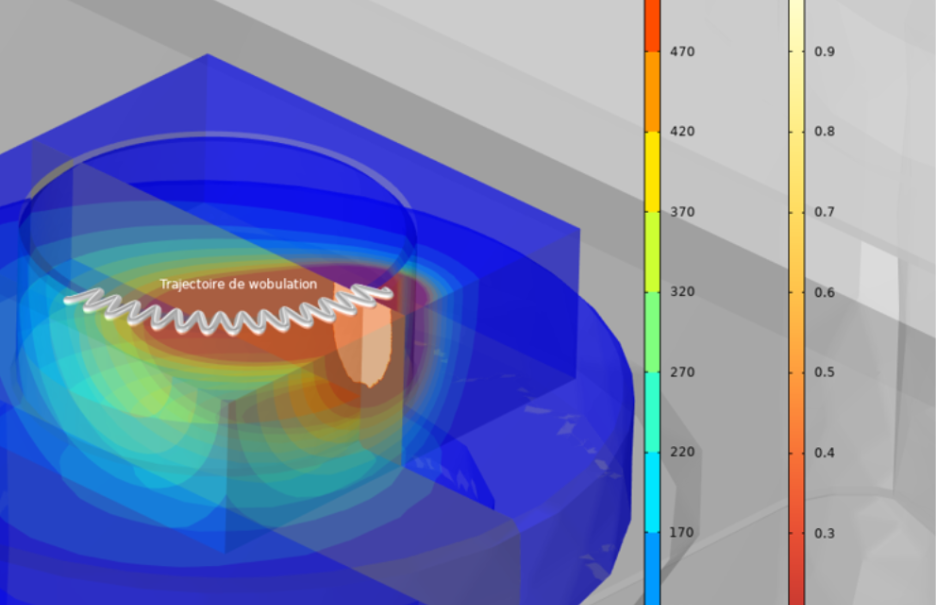
Based on the part geometry, materials, boundary conditions and project objectives, it is possible to model the thermal and mechanical history of the process and study different scenarios.
The results make it possible to anticipate, in particular:
- The temperatures reached;
- The areas subject to significant heating;
- Heat accumulation;
- The areas likely to be affected by the process;
- Potential distortion;
- The influence of different strategies or configurations.
The aim is therefore not to eliminate experimentation, but to better target the configurations worth testing.
Different challenges depending on processes and sectors
Simulation can address different issues depending on the industrial application.
Large-scale additive manufacturing
In additive manufacturing, particularly as part dimensions increase, heat accumulation and distortion can become major issues.
Simulation makes it possible to study different deposition strategies and anticipate the thermal behaviour of the part in order to guide the manufacturing strategy before the first trials.
The challenge is twofold: securing the process and limiting the risk of scrap and material waste.
Laser welding
When welding complex parts or electrical components, simulation makes it possible in particular to assess the energy needed to achieve sufficient fusion while controlling the heating of surrounding areas.
It can thus help to prevent overheating, distortion or damage to sensitive components.
Laser hardening
In the case of laser hardening, simulation makes it possible to study the thermal cycle, the depth of the hardened zone and the extent of the treated area.
It also helps to ensure that the treatment remains under control, without causing surface melting or altering areas that must not be affected.
In each of these applications, the objective remains the same: to obtain a reliable prediction early enough to secure the process before the first physical trials.
Simulation integrated into IREPA LASER’s process expertise
The value of simulation does not rest solely on the numerical model. It also depends on its ability to represent the real process accurately.
That is why, at IREPA LASER, simulation comes into play from the very first stages of our support, complementing our expertise in laser processes.
Our approach is based on a thermomechanical model developed in COMSOL Multiphysics®, fed in particular by:
- the actual or representative geometry of the part;
- the material properties;
- the boundary conditions;
- the industrial objectives;
- the process parameters and conditions.
The model can then be used to study different scenarios and, in particular, to predict temperatures and distortions.
The results can then guide the choice of paths, the deposition sequence or the energy input before physical trials are carried out.
Simulation and experimentation: two complementary approaches
Simulation does not replace trials.
On the contrary, comparing simulation with experimentation lies at the heart of the approach.
The numerical results can be compared with the measurements obtained during trials in order to check the relevance of the model and refine it where necessary.
This experimental calibration gradually improves the reliability of the predictions and secures the final process.
The approach developed by IREPA LASER thus combines:
Modelling → Simulation → Laser trials → Measurements → Correlation → Optimisation
This complementarity means simulation can be used as a genuine decision-making tool throughout development, from feasibility study through to industrialisation.
When simulation becomes a true numerical design of experiments
An example of the laser welding of electrical relays illustrates this approach in practice.
The objective was to achieve sufficient fusion at the metal interface while keeping the temperature of the sensitive surrounding areas below 150 °C.
A transient thermal model was built in COMSOL Multiphysics ® based on the actual geometry of the assembly and its thermophysical properties. The laser beam was represented as a moving heat source taking into account, in particular, the power, travel speed, spot diameter, effective absorptivity and welding path.
Several scenarios were then simulated to identify the configurations that simultaneously make it possible:
- to deliver sufficient energy to form the weld bead;
- to limit the temperature of the sensitive areas;
- to control heat accumulation;
- to maintain a safety margin relative to the 150 °C threshold.
Simulation thus made it possible to rule out, at an early stage, configurations likely to lead to insufficient fusion or excessive heat accumulation.
After correlating the numerical results with the experimental measurements, the laser parameters were validated in a third of the usual time.
In this case, simulation acted as a numerical design of experiments, making it possible to focus the physical trials on the most relevant configurations.
What are the benefits for manufacturers?
By reducing the number of experimental iterations required, simulation helps shorten the development cycle and secure the key stages of a project.
In particular, it makes it possible to:
- reduce the number of physical trials;
- limit scrap and material consumption;
- reduce the machine time required;
- anticipate overheating and distortion;
- secure the development of costly or sensitive parts;
- better justify the choice of parameters;
- shorten set-up and development times;
- make technical decisions more quickly;
- better understand the physical phenomena at work in the process.
In an industrial environment where development lead times and meeting milestones are critical, having reliable data earlier makes it possible to reduce iterations and accelerate the transition from study to production.
Simulate to experiment better
Laser process simulation therefore brings a new dimension to process development: it makes it possible to explore different configurations virtually before testing them against the reality of the machine.
But its real value lies in its integration into overall process expertise.
At IREPA LASER, simulation and experimentation are complementary: modelling helps to better understand and guide, while trials make it possible to measure, compare and validate.
This approach enables manufacturers to reduce uncertainty, target their trials and progressively secure their laser processes, from feasibility study through to industrialisation.