
Laser welding of copper: industrial experience and process control
Copper is now establishing itself as a strategic material in many industrial sectors: vehicle electrification, e-mobility, energy storage, electric motors, power electronics.
While its electrical and thermal properties make it an essential material, joining it by laser has long been considered complex.
At IREPA LASER, we help manufacturers master the laser welding of copper, combining industrial experience, the right choice of technology and advanced process control.
>> To explore the topic further, watch the webinar replay: Laser welding – how to weld copper by laser
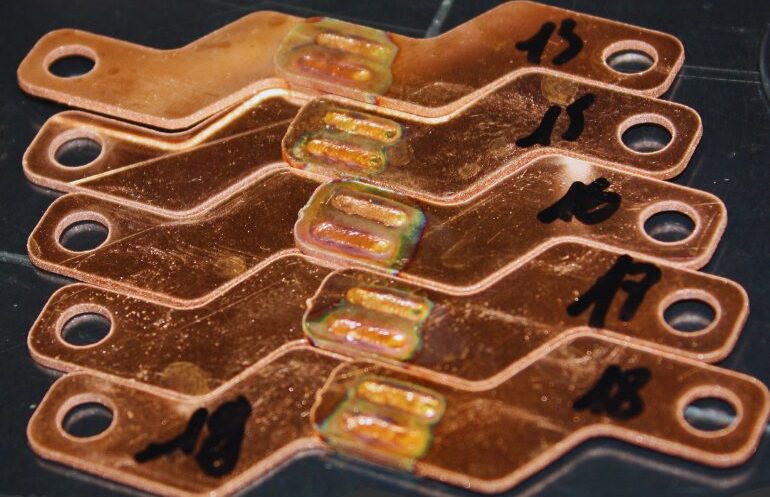
Industrial case study: welding copper/aluminium connections on lithium modules
As part of an industrial project, IREPA LASER was asked to weld copper/aluminium connections on lithium modules.
Project constraints
- Limited temperature rise (< 80°C)
- High mechanical and electrical requirements
- Interim production before installation of a dedicated line
Solution implemented
- Design of tooling
- Scanner head with dynamic trajectories
- Precise control of power and speed
- Inspection procedure
Results
- 1 200 modules welded
- 193 000 spots completed
- Zero non-conformities
- Mechanical and electrical performance validated
This project demonstrates that a correctly sized process can secure sensitive applications, including in environments with severe thermal constraints.
Industrial case study: welding hairpins for electric motors
In modern electric motor architectures, copper hairpins require a large number of welds with:
- Repeatability requirements
- High productivity
- Automated integration
Solutions combining a central beam + ring and dynamic trajectories enable:
- Stabilisation of the melt pool
- A reduction in defects
- Throughput compatible with series production
Laser welding is establishing itself here as a key technology supporting the industrialisation of e-mobility.
Why is copper difficult to weld by laser?
The challenges of laser welding copper stem from its intrinsic properties.
1) High reflectivity at room temperature
At the wavelengths traditionally used in metal welding (≈ 1 µm, near infrared), copper has very low absorption (≤ 5 %).
Most of the incident energy is therefore reflected, which makes initiating the process more difficult.
2) High thermal conductivity
Copper dissipates heat very quickly. The energy input must be sufficiently concentrated to reach melting rapidly and stabilise the welding regime.
3) An unstable melt pool
In the liquid state, copper has:
- Low viscosity
- Reduced surface tension
These characteristics can cause:
- Porosity
- Spatter
- Keyhole instabilities
Process control therefore relies on rapid, controlled energy input adapted to the kinetics of the material.
Technological developments that are changing the game
Recent advances in laser sources have profoundly transformed the ability to weld copper robustly.
Diversification of wavelengths
The emergence of sources:
- Green (~515 nm)
- Blue (~445 nm)
significantly improves the initial absorption of copper. These solutions make the process easier to start and secure laser-material coupling.
High beam quality fibre lasers
Single-mode fibre lasers make it possible to achieve high surface energy densities thanks to a highly concentrated beam.
This configuration promotes:
- Rapid achievement of the keyhole regime
- A more stable interaction
- A reduction in spatter
Beam geometry and advanced modulation
Today, a laser beam is no longer necessarily circular and uniform. Available solutions allow:
- Dual fibres
- Dynamic modulation of beam shape
These approaches offer fine adjustment of the energy input according to the joint and geometry.
Real-time monitoring and control
To guarantee industrial robustness, it is now possible to integrate:
- Part position detection
- Automatic focal point adjustment
- Process monitoring and measurement during operation
- Post-weld inspection
Mastering the laser welding of copper depends as much on the source as on the control ecosystem.
R&D focus: exploring the nanosecond laser
As part of the SOLANACEE collaborative project, supported by the Grand Est Region and Europe, IREPA LASER explored the potential of the nanosecond laser for copper welding.
Objectives:
- Study alternative interaction regimes
- Characterise the joints obtained
- Develop a solution transferable to an industrial environment
An R&D demonstrator was developed and installed at the industrial partner’s site, marking an important step towards industrialisation.
A comprehensive approach: technology + process + safety
Successful laser welding of copper does not depend solely on the choice of source. It requires:
- A detailed understanding of the interaction mechanisms
- Appropriate definition of process parameters
- Controlled integration into the industrial environment
- Safeguarding installations against optical reflections
It is this comprehensive approach that IREPA LASER puts at the service of manufacturers.
Watch the webinar replay
To explore the topic further, watch the full presentation by Frédérique Machi, laser welding expert: Laser welding – how to weld copper by laser.
On the agenda:
- Technological fundamentals
- The specific features of laser–copper interaction
- The available levers for action
- Detailed industrial case studies
>> Need further information about your copper applications or your industrialisation constraints? Contact our experts to discuss them.