
Simulation of laser hardening of a bimetallic component
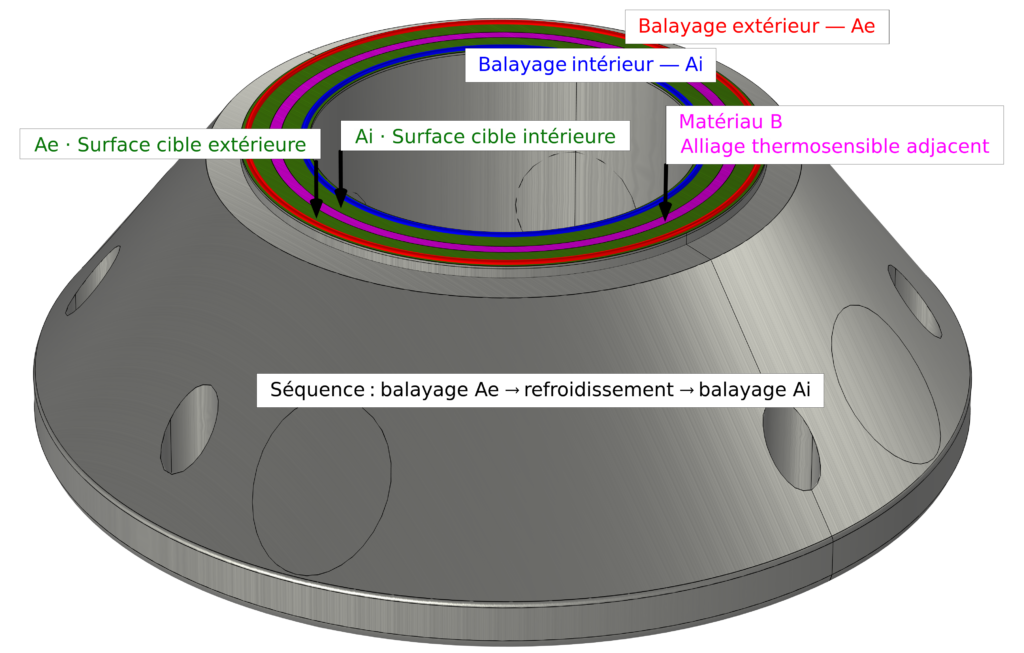
IREPA LASER simulated pulsed laser hardening on two concentric annular target surfaces of a carbon steel component: the outer surface (Ae) and the inner surface (Ai). The objective was to exceed the thermal threshold of 850 °C at the surface and at a specified depth within the steel, while keeping material B, an adjacent heat-sensitive alloy, below the temperature limit of 180 °C.
Industrial need
Evaluate a selective laser hardening strategy for surfaces Ae and Ai of material A, while protecting material B. The treatment had to ensure continuous thermal coverage along both scan paths, reach the target depth, and meet the cooling requirements specified by the customer for the intended hardening transformation.
IREPA LASER solution
IREPA LASER developed a transient thermal model using COMSOL Multiphysics to analyse the heating and cooling cycles associated with pulsed laser processing. The simulation reproduces the outer scan, followed by a cooling phase with the laser switched off, and then the inner scan. The calculation preserves the component’s thermal history: the inner scan starts from the temperature field resulting from the first scan and the intermediate cooling phase.
Technical challenge
The treatment must raise the target regions of material A above the thermal threshold of 850 °C, associated with austenitisation, while keeping its surface temperature below the reference melting temperature of 1,500 °C. At the same time, the temperature of material B must remain below the 180 °C limit.
Pulsed operation, pulse overlap, and cooling between scans influence energy distribution and heat accumulation within the component. Accounting for these factors makes it possible to assess surface and subsurface heating, thermal coverage of the target areas, and protection of the adjacent alloy.
Results achieved
The maps show the maximum temperature reached at each point during the treatment cycle. The 850 °C contours and thermal coverage maps identify the regions where the thermal threshold is reached, both at the surface and in the plane located at the investigated depth. These local temperature maxima may occur at different times during the treatment.
The calculated maximum surface temperatures reach approximately 1,466 °C on Ae and 1,437 °C on Ai, remaining below the reference melting temperature of material A. On the selected adjacent surface of material B, the calculated maximum temperature is 102.3 °C, below the 180 °C limit.
Analysis of the local temperature histories also shows that the calculated cooling conditions meet the customer’s requirements for the intended hardening transformation. The cooling rates and detailed process parameters remain confidential.
These results make it possible to assess temperature control at the surface and at the target depth, as well as the protection of the adjacent material. However, as the model is exclusively thermal, reaching the 850 °C threshold does not, in itself, demonstrate the final hardness or the actual hardened depth.