
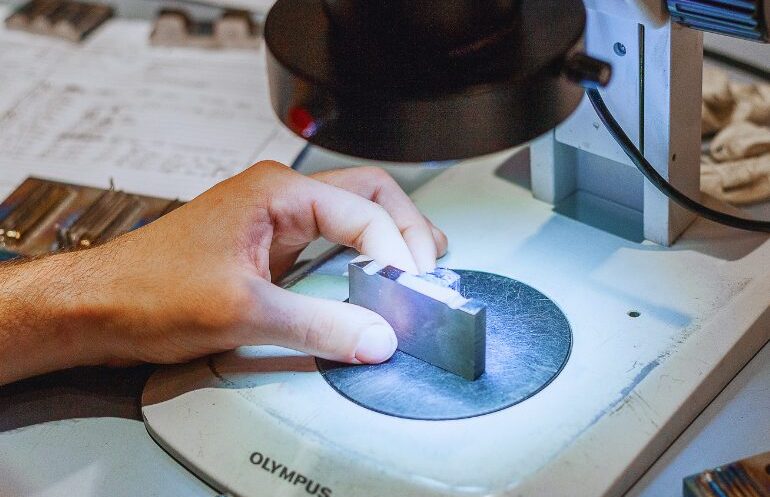
Inspecting laser welds: beyond compliance
In laser welding, quality inspection is an essential step. It is used to verify the compliance of joints, to ensure that technical requirements are met and to validate the quality of the parts produced.
However, a compliant inspection does not always mean that the process is fully under control.
In many cases, the true performance of a laser welding process lies not only in the final result, but in understanding the physical phenomena that take place during the welding operation.
Inspecting a weld is not the same as understanding the process
In industrial production, inspections generally cover several key criteria:
- The appearance of the weld seam
- The dimensions of the welded joint (penetration, top bead width, width at the interface, for example)
- Leak tightness
These inspections make it possible to verify that the weld meets the expected specifications.
However, they mainly assess the result obtained. They rarely provide information on the mechanisms that led to that result.
Yet in laser welding, these mechanisms are particularly complex.
An extremely dynamic process
Laser welding involves a highly localised interaction between the laser beam and the material.
Under the effect of the high energy density, a melt pool forms within a few milliseconds. Depending on the operating conditions, a vapour capillary (keyhole) appears, enabling deep penetration of the energy into the material.
Throughout the welding process, several phenomena evolve simultaneously:
- Melt pool movements;
- Variations in keyhole stability;
- Heat exchange;
- The flow of liquid metal;
- Solidification of the material.
These phenomena constantly interact and can change very quickly depending on the process parameters.
A slight variation in power, travel speed, focusing or part positioning can alter the behaviour of the melt pool.
Why are some defects not visible on the surface?
The appearance of a weld seam provides an initial indication of the quality of a joint, but it does not necessarily reflect all the phenomena that occurred during welding.
Some very brief instabilities can disappear before the melt pool has fully solidified while still leaving internal defects.
Defects that may be encountered include:
- Porosity;
- Microcracks;
- Geometric defects;
- Incorrect positioning of the welded joint.
Depending on the application and quality requirements, suitable inspection methods may be needed to identify these defects.
The challenge is therefore not to limit the analysis to the final appearance of the weld, but to understand the phenomena that led to its formation.
From inspection to process control
The best-performing manufacturers are no longer content with inspecting parts after production.
They also seek to answer several key questions:
- Which physical phenomena really influence weld quality?
- Which process parameters are the most decisive?
- How can a drift be detected before it causes a defect?
- Which indicators ensure process stability?
This approach turns quality inspection into a genuine process control tool.
The objective is no longer simply to verify the compliance of the parts produced, but to understand the causes of any variations in order to improve production repeatability over the long term.
Training: a lever for better understanding laser welding
Mastering a laser welding process does not depend solely on equipment or inspection systems.
It also depends on the skills of the teams who implement it.
Understanding laser-material interactions, melt pool behaviour, the effects of process parameters and the origin of the main defects enables operators, technicians and engineers to make better-informed decisions during set-up, industrialisation and optimisation phases.
This upskilling helps to:
- Improve process stability;
- Facilitate the interpretation of inspection results;
- Optimise settings;
- Enhance weld reproducibility;
- Limit non-conformities;
- Develop new products;
- Improve the company's competitiveness;
- …
Developing an in-depth understanding of the process with IREPA LASER
For more than 40 years, IREPA LASER has been helping manufacturers master laser processes.
The training courses offered by LASER ACADEMY combine scientific knowledge, industrial feedback and hands-on practice on laser equipment, enabling participants to understand process behaviour and acquire the skills needed to control it.
Beyond learning settings, the aim is to give teams the keys to analyse physical phenomena, interpret relevant indicators and build a robust, reproducible process adapted to industrial constraints.
Discover our laser welding training courses
Would you like to deepen your understanding of laser welding, improve control of your processes and develop your teams' skills?
Discover LASER ACADEMY training courses or contact our experts to identify the programme best suited to your needs.