
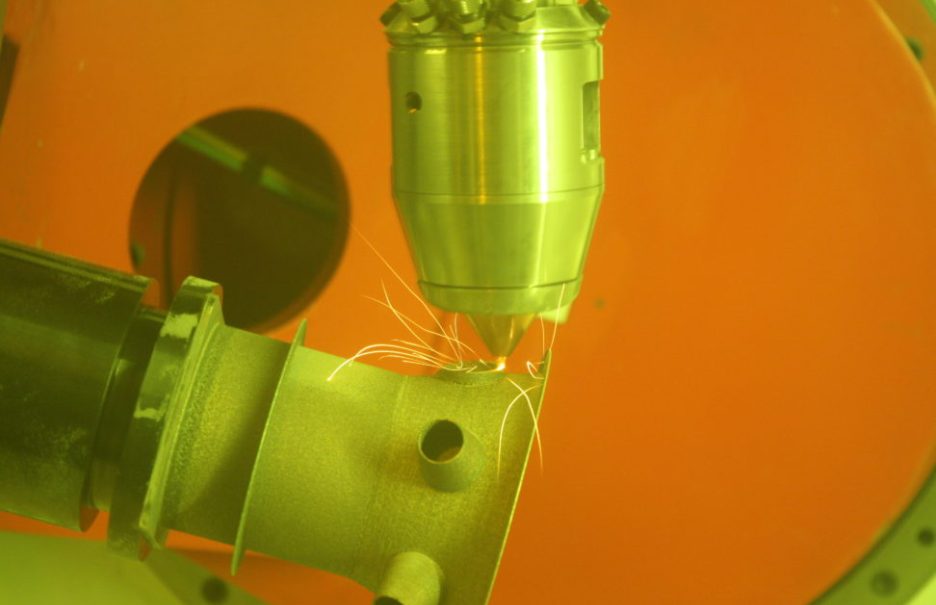
Our expertise at ICWAM

17 to 19 May 2017 – Metz
Organised by the Institut de Soudure, the École Centrale de Nantes, the Association Française du Soudage and the International Institute of Welding, the first edition of the ICWAM international congress focuses on welding, additive manufacturing and the associated non-destructive testing.
Don’t miss our experts’ presentations:
■ Philippe ACQUIER, R&D Engineer, Additive Manufacturing: ‘Influence of build strategies on the manufacture of large Ti-6Al-4V parts using the LMD-CLAD® process’
■ Ludovic KOUNDE, R&D Engineer, Simulation and Modelling: ‘Additive manufacturing: the effects of build strategies on parts’
■ Catherine SCHNEIDER-MAUNOURY, PhD student, Additive Manufacturing: ‘Use of the LMD-CLAD® process to produce functionally graded materials with a Ti6Al4V-Mo alloy’
Conference abstracts
Effect of construction strategies on large-scale Ti-6Al-4V part manufactured by the Laser Metal Deposition CLAD® process.
Philippe Acquier1,a, Didier Boisselier1,b, Jérôme Wursthorn1,c, Ana Maria Fernandez Blanco2,d, Ludger Weber2,e and Andreas Mortensen2,f
1IREPA LASER, Pôle API – parc d’innovations, 67400 Illkirch, France
2EPFL, MXD 038 (Building MX), Station 12, CH – 1015 Lausanne, Switzerland
apa@irepa-laser.com, bdb@irepa-laser.com, cjw@irepa-laser.com, dana.fernandezblanco@epfl.ch, eludger.weber@epfl.ch, fandreas.mortensen@epfl.ch
Laser Direct Metal Deposition processes are applied for the manufacturing of medium to large scale parts in a wide range of materials. With the increase of the size of the part, its distortion along with the robustness of the process during long manufacturing time play a major role. The operating conditions and the construction strategies have to be optimized in order to achieve the expected quality of the part.
Based on additive manufacturing with the LMD process called CLAD® and within the framework of the EU funded FP7 AMAZE project, a large-scale demonstrator (>1m) has been fabricated.
This paper will present the different steps associated with the manufacturing of this part: materials parameter validation, NDTs, mechanical characterization, sub-elements construction and final demonstrator manufacturing. It will also emphasize on the encountered issues during manufacturing and the solutions which have been set-up to fix them.
Additive manufacturing: the effects of build strategies on parts
Additive Manufacturing (AM), including Direct Additive Laser Construction (CLAD®), makes it possible to produce bespoke metal parts without tooling and with very short lead times.
However, since AM is based on a thermal process that subjects the material to complete processing cycles (heating – melting – solidification – cooling), parts produced by AM are subject to residual stresses that can lead to distortion, dimensional variations or even cracking. It is therefore essential to assess or quantify these thermomechanical stresses in order to predict where they occur and the resulting distortion.
These issues were studied through modelling and numerical simulation of the build strategies for several types of part, and three different build strategies were tested. A specific fixture was designed to limit the effects of clamping on the substrate. Temperature and distortion measurements were taken on the substrate during manufacture, and residual stresses were measured after the build.
A comparison between numerical modelling and experimental measurements was carried out and will be presented in this talk.
Use of the LMD-CLAD® process to produce functionally graded materials with a Ti6Al4V-Mo alloy
The aim of the work presented is to manufacture functionally graded materials (FGM: Functionaly Graded Material) using a melted powder deposition process called CLAD® (Construction Laser Additive Directe). FGMs are materials whose chemical composition, and therefore their mechanical and microstructural properties, varies gradually in one or more directions. The benefit of such materials is the possibility of combining and concentrating the advantages of two (or more) materials within a single part.
Once the chemical composition of each element has been defined, the powders are mixed and then injected under the laser beam. The chemical composition can be adjusted layer by layer to create a composition gradient. Using two powder feeders makes it possible to produce unique, bespoke alloys. One of the aims of this study is to adapt the process to combine materials with different thermophysical properties, such as melting temperature (1674°C for Ti6Al4V and 2617°C for Mo). The process parameters must also be adapted to melt both materials under the laser beam.
Various walls with composition gradients were produced, ranging from the simplest gradient to a more complex one. The chemical composition changes from 100% Ti6Al4V at the start of the build to 100% Mo at the top of the wall. Between the first and last layers, the percentage of Ti6Al4V and Mo increases or decreases by 50%, 25% or 20% between each gradient step.
The walls produced were characterised using various methods in order to determine, for each composition gradient: the phases present (XRD), the content of each chemical element (EDS), grain morphology and crystallographic texture (EBSD), mechanical properties (micro-hardness) and the distribution of the elements (tomography).
View the preliminary programme