
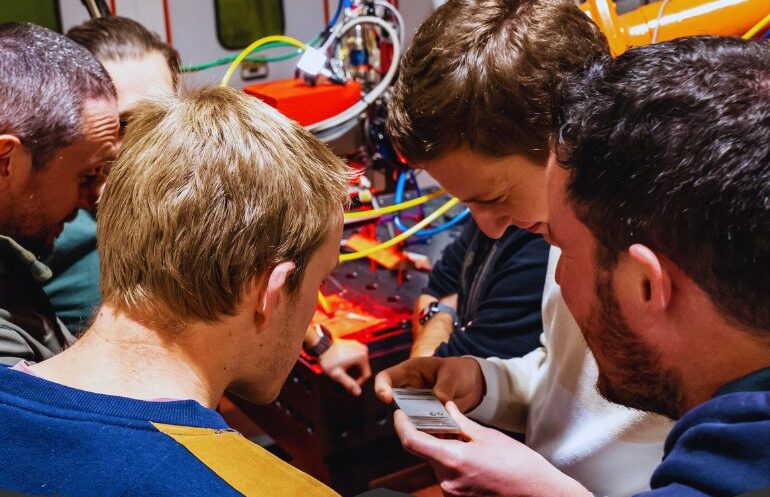
Training welding operators to rebuild industry
In many industrial sectors, the shortage of qualified welding operators is a major challenge. These professionals, long regarded as mere operatives, are now strategic links: their expertise determines the quality, safety and productivity of production lines. In shipyards, power plants, aerospace workshops or maintenance sites, a lack of specialist skills can slow down throughput, lead to rework and limit innovation. It is therefore crucial both to train new welding operators and to change practices in order to produce more efficiently, even with constrained human resources.
Developing laser welding skills: a lever for industry
IREPA LASER sees the development of laser welding skills as an essential lever for securing and modernising industrial processes. Laser welding, a cutting-edge technology, meets demanding requirements: micrometre precision, speed, consistent quality and enhanced safety. But beyond its technical performance, it provides a structural response to the skills shortage.
Indeed, laser welding makes it possible:
- To reduce dependence on complex manual skills,
- To facilitate the automation of operations,
- And to standardise joint quality.
So rather than requiring a large number of highly specialised welders, it becomes possible to rely on controlled processes, run by operators trained in the technology who can supervise, adjust and secure operations.
Training professionals in laser welding is therefore not just about developing a new skill: it means adapting industrial organisations to produce more, better, and with better control of the available human resources.
Training in laser welding is not just about operating a machine. It is about mastering a complete set of skills: precise parameter settings, joint inspection, process safety, and adaptation to different materials and industrial configurations.
At IREPA LASER:
- The Qualiopi-certified LASER ACADEMY training centre trains more than 1 300 professionals each year, with a 99 % satisfaction rate for meeting objectives.
- Training courses combine theory and practice on modern laser equipment.
- Each programme is designed to be directly applicable in the field.
- Trainers are certified and accredited, guaranteeing reliable and safe expertise.
- Modules can be tailored to participants’ level and companies’ needs.
Investing in the training of welding operators means rebuilding industry by strengthening skills, securing processes and enabling companies to innovate with confidence.
Laser welding: a high-performance, reliable technology
Laser welding stands out for its superior performance compared with traditional processes (TIG, MIG/MAG, resistance welding). It concentrates energy on the working area, reducing distortion and rework. It also allows high welding speeds while guaranteeing consistent quality, even on complex or sensitive materials.
Contrary to some preconceived ideas:
- Laser welding is no more expensive than conventional processes when the overall process cost is considered.
- It can weld a wide range of materials: steels, stainless steel, aluminium, copper, titanium or special alloys.
- It ensures sufficient penetration for strong, reliable joints, even without filler metal.
- Its technical complexity is not an obstacle when it is mastered and secured.
By combining speed, precision and a low energy footprint, laser welding becomes a strategic tool for producing better, faster and with measurable quality.
A wide range of industrial sectors benefit from laser welding
This technology is no longer reserved for the automotive industry. It adapts to many industrial sectors where precision and repeatability are essential:
- Energy and industrial production: critical applications where safety and reliability are the priority.
- E-mobility and batteries: joining multi-material components requiring conductivity, tightness and lightweighting.
- Boilermaking and fine metalworking: butt joints and complex assemblies with precision requirements and minimal distortion.
Recent projects carried out by IREPA LASER show tangible results
In the electric mobility sector, applying laser welding to lithium batteries made it possible to produce 60 000 parts with 17 km of inspected welds, while keeping the scrap rate below 3.5 %. These results reflect industrialised quality and repeatability, with reliability guaranteed from the upstream production phase.
In aluminium joining, using laser welding on critical series made it possible to increase the production rate by 120 % while significantly reducing porosity. The quality and robustness of the joints were ensured by a controlled and secure process.
In boilermaking and fine metalworking workshops, laser welding offers extreme precision, with virtually zero distortion and welding speeds of up to 20 m/min. The process is compatible with automation, can be used in sensitive areas and enables a variety of materials to be joined efficiently in complex configurations.
These figures illustrate the ability of laser welding to secure and optimise industrial processes in demanding contexts.
Discover our laser welding training courses
To develop these critical skills, IREPA LASER offers comprehensive training programmes designed to make participants immediately operational in the field.
>> Discover our laser welding training catalogue and identify the solution best suited to your needs.
>> Need further information? Contact us.